How to select a marble block: a buyer’s checklist
A marble block should be judged against the slabs it is expected to produce. This guide explains what to measure, inspect and agree before accepting a block.
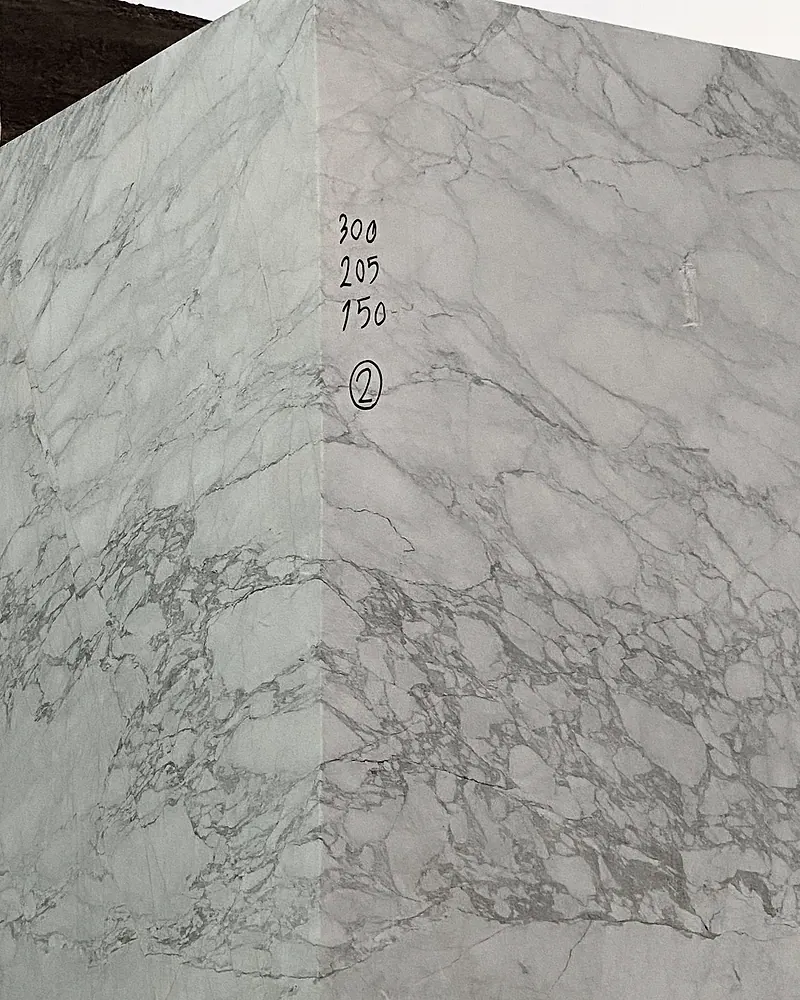
Select a marble block against the finished pieces you intend to produce. Fractures, irregular geometry and visual variation can change the amount of acceptable material recovered from a purchase; the outer dimensions alone cannot establish that recovery. Studies of dimension-stone extraction and marble quality assessment show why geometry and appearance need separate consideration.12
Start the inquiry with the required slab or component dimensions, finished thickness, intended finish and visual range. Ask the receiving processor to review these requirements before approving the block. Define the output, inspect the actual stone, then record the permitted exceptions.
Dimensions: establish the usable envelope
EN 1467:2022 distinguishes gross, net and commercial block dimensions. Gross size describes the smallest rectangular box enclosing the block. Net size describes the largest inscribed rectangular block, excluding features such as drill holes and other holes. Commercial measurement addresses recognized defects and commercial reductions. State which basis governs the quotation and how deductions are calculated.3
Do not treat a net measurement as certification of a sound interior. Geometry and discontinuities require separate assessment.13 For an irregular block, ask the inspector to draw the proposed rectangle onto photographs and record the minimum usable dimensions. Mark the axes and proposed slab plane so that height and width cannot be confused between the quarry and the saw operator.
Give the processor the dimensional record before comparing prices. Request a cutting sketch that identifies edge trimming, known exclusions and the intended finished pieces. There is no universal commercial block size that settles suitability: dimensional limits require agreement, while geological structure constrains the sound pieces recoverable.13
Keep weight estimates distinct from measurements. A hypothetical rectangular block measuring 3.0 × 2.0 × 1.5 metres occupies 9.0 cubic metres. At an assumed density of 2.7 tonnes per cubic metre, its calculated mass is 24.3 tonnes. That density is a preliminary planning approximation within published marble guidance, not a measured property of an offered block.4
Ask the logistics provider to assess the selected block before commitment. Container suitability also depends on cargo support, concentrated loading and securing; a mass figure alone does not establish a workable loading arrangement.5
Soundness: map the features that affect cutting
Examine accessible faces for open fractures, cavities, broken corners and repaired areas. Ask the inspector to trace visible discontinuities across adjoining faces and photograph their positions relative to the proposed cutting plane. Their orientation and spacing matter because they influence recoverable stone geometry.1
Keep a face-by-face condition record. Distinguish what was observed from what remains uncertain: an inaccessible underside should be recorded as uninspected. Request specialist assessment where a feature could compromise the intended pieces. External examination cannot reveal the entire interior; marble-quality research relies on sampling and estimation precisely because information is incomplete.2
Assess visual character and fabrication condition separately. The Natural Stone Institute’s marble soundness classification concerns working properties and explicitly excludes market value. It therefore should not be read as an aesthetic ranking, or substituted for inspection of the particular block being purchased.6
Be equally precise about repairs. NSI guidance recognizes filling and reinforcement among the fabrication measures used for some marble groups.7 Request disclosure of known resin, filling, reinforcement and previous repairs, with their locations marked. Ask the processor what further treatment is anticipated and whether it is acceptable for the intended use. Require an explanation of the proposed repair and its implications for acceptance.
Background: agree a range of acceptable appearance
“White background” needs a physical reference. The NSI manual recommends reviewing enough samples to demonstrate the material’s colour range, rather than selecting marble from one sample. It also distinguishes finishes: polished marble is reflective, while a honed surface has little or no gloss.7
Use that guidance to create a practical approval set. Request samples representing the lightest and darkest acceptable background, together with examples of acceptable clouding, inclusions and crystalline texture. Label the intended finish. Keep corresponding reference sets with the buyer and supplier, and record which samples define the acceptance boundary.7
For remote review, request photographs under comparable lighting, identify whether surfaces are wet or dry, and ask for unedited originals. Include the block identifier and a scale reference in the image set. Treat this as a consistent documentation protocol, with physical samples retained for colour approval.
Review the proposed batch together. Quarry-specific quality systems can combine colour, texture and defects, so a label such as “first choice” needs a written definition for the purchase.2 Specify whether a stronger grey area is acceptable anywhere, only in designated pieces, or outside the approved range. These are buyer decisions to agree explicitly.
Veining: approve the cutting direction
A block’s most attractive exposed face should prompt a discussion with the saw operator. Cutting orientation changes the pattern revealed: the NSI manual distinguishes cuts across and along the material’s bedding, while noting that the visually useful direction depends on the marble.7
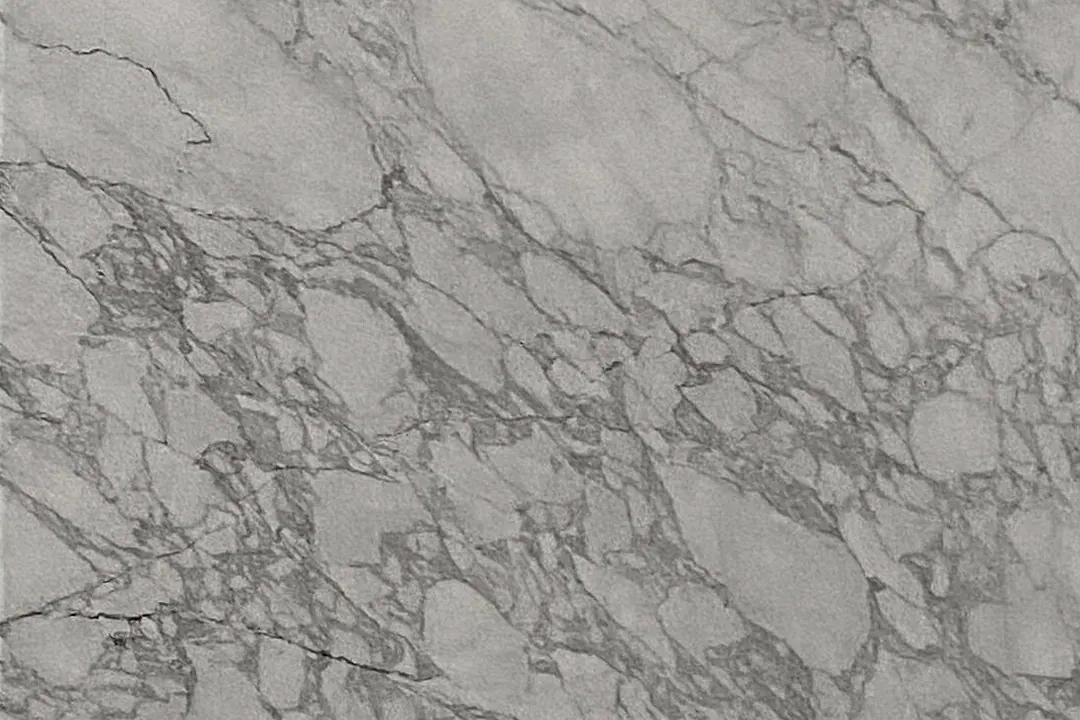
Ask the processor to mark the proposed slab plane on the block photographs. Then describe the desired result in plain terms: broad diagonal movement, a fine network, widely spaced veins or a comparatively quiet field. Request supporting examples from comparable material, identified clearly as examples rather than predictions of this block’s interior.
Where book-matching is intended, settle that requirement before sawing and finishing. Book-matching uses adjacent slabs with the faces that originally faced one another finished and arranged as an approximate mirror image. Natural patterns can change even between neighbouring slabs, so exact symmetry should not be promised.8
Ask for slab sequence and orientation to be preserved through processing. For an architectural composition, review the actual slab images against the proposed joints, openings and cutouts before approving fabrication. The NSI’s book-matching guidance recommends photographic layouts, mockups and final layout approval; a reflected image of one surface remains a design study, not evidence of the finished pair.8
Translate selection into an acceptance record
Use one block identifier across the quotation, dimensional record, photographs and dispatch documents. Attach the agreed exceptions to that record. The checklist below draws on rough-block requirements, quality research and fabrication guidance.237
| Check | Record before acceptance |
|---|---|
| Dimensions | Measurement basis, minimum usable dimensions and agreed deductions.3 |
| Soundness | Mapped visible features, repairs and uninspected faces.12 |
| Background | Approved range samples and intended finish.7 |
| Veining | Marked cutting plane and any slab-sequence requirement.78 |
| Exceptions | Features accepted, excluded or awaiting further assessment.23 |
For project material, address performance evidence separately. ASTM C503/C503M-23 covers marble dimension stone and properties including absorption, density, compressive strength, abrasion resistance and flexural strength. Naming the specification in an offer does not demonstrate that the supplied material meets it.9
Request representative test reports that identify the material and test methods. Have the project team determine which evidence is relevant to the eventual application: anchorage, walking surfaces and exterior exposure can require different investigations. Visual approval cannot establish those performance characteristics.910
Finally, ask the processor to estimate acceptable output from the proposed cutting plan, identifying assumptions and unresolved features. Compare offers on that basis. Block-geometry and quality research make the commercial point plainly: a lower purchase price per tonne can be outweighed by reduced recovery of the required pieces.12 Treat any quoted recovery rate as an estimate requiring stated assumptions.
Before placing the order, write down when inspection occurs, who accepts the block and how discrepancies discovered at receipt or during initial processing will be documented and reviewed. Make any agreed remedy explicit. Give the supplier a usable specification, and give the receiving factory the same approved record.
PETRA ALTA offers Sereno & Nevato primarily as rough blocks, with selection by dimensions, quality, background and natural veining subject to quarry availability.11 For block inquiries, send your target dimensions and visual references through the block inquiry.11
Sources
Superscript numbers in the text refer to these sources.
- 1Mosch et al.; Environmental Earth Sciences, Springer Nature. Optimized extraction of dimension stone blocks (opens in a new tab). Published online 2010-11-30; journal issue 2011. Accessed 2026-09-29.
- 2Kapageridis and Albanopoulos; Journal of the Southern African Institute of Mining and Metallurgy. Resource and Reserve estimation for a marble quarry using quality indicators (opens in a new tab). January 2018. Accessed 2026-09-29.
- 3CEN / Slovenian Institute for Standardization; iTeh-hosted preview. EN 1467:2022: Natural stone: Rough blocks: Requirements (opens in a new tab). 2022 edition, particularly definitions and measurement criteria. Accessed 2026-09-29.
- 4CEN; iTeh-hosted preview. CEN/TR 17024:2017: Natural stones: Guidance for use of natural stones (opens in a new tab). 2017-01-17. Density guidance supports the explicitly hypothetical mass calculation. Accessed 2026-09-29.
- 5IMO/ILO/UNECE. CTU Code, section 7.2: Suitability for the cargo (opens in a new tab). 2014 code; online presentation. Accessed 2026-09-29.
- 6Natural Stone Institute. Marble Soundness Classification (opens in a new tab). Undated. Accessed 2026-09-29.
- 7Natural Stone Institute. Dimension Stone Design Manual: Marble and Onyx (opens in a new tab). 2022 edition. Guidance on samples, finishes, cutting direction, soundness and fabrication repairs. Accessed 2026-09-29.
- 8Karin Kirk; Use Natural Stone / Natural Stone Institute. Bookmatching: Geology Meets Geometry (opens in a new tab). 2018-12-21. Accessed 2026-09-29.
- 9ASTM International. C503/C503M-23: Standard Specification for Marble Dimension Stone (opens in a new tab). 2023 edition. Accessed 2026-09-29.
- 10Natural Stone Institute. Natural-stone testing services and methods (opens in a new tab). Undated live resource. Accessed 2026-09-29.
- 11PETRA ALTA. Sereno & Nevato: product and supply information. 2026.