From mountain to slab: how marble is quarried and processed
Follow the production decisions that connect a marble quarry face to a finished slab. Learn what to clarify about usable dimensions, cutting direction, treatments and final acceptance.
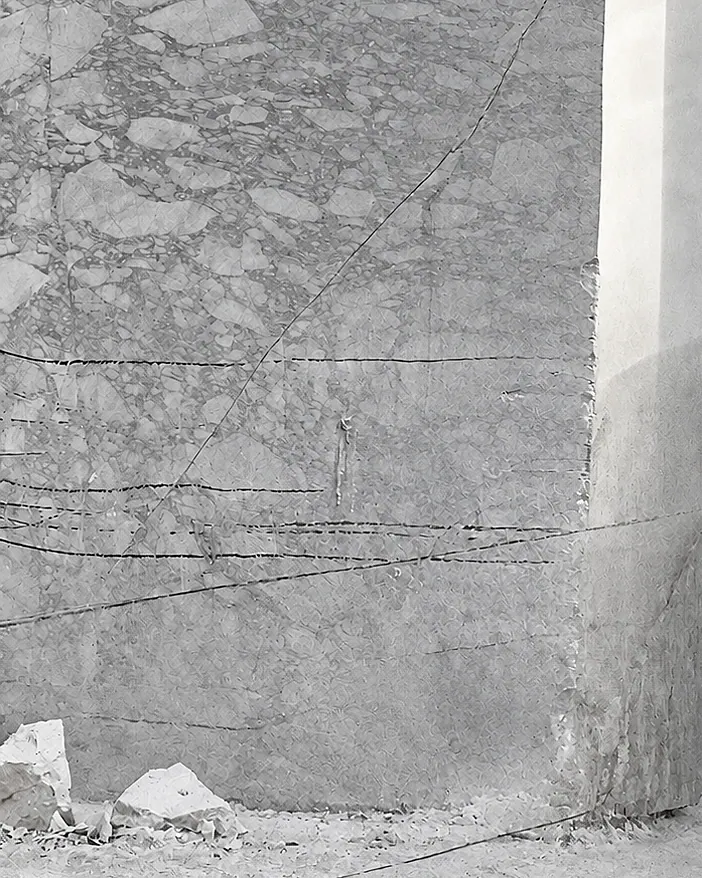
A marble block is purchased for what a processor expects to recover from it. Joint spacing, block geometry and cutting orientation help determine whether that purchase can become the required slabs. The useful commercial question is how much acceptable finished material a particular block can provide. That judgment begins at the quarry face.1
For importers, processors and specifiers, following those decisions through extraction, squaring, sawing and finishing makes the purchase easier to evaluate. The methods described here draw on quarry research, equipment documentation and technical guidance; individual operations use different combinations of machinery and treatment.23412
Read the rock before planning the cuts
In dimension-stone quarrying, the objective is to recover intact pieces with useful dimensions. Naturally occurring joints divide the rock mass, and their spacing and orientation constrain the blocks that can be extracted. A large exposed face may contain closely spaced discontinuities that prevent recovery of equally large, sound blocks.1
Bench planning brings these geological limits together with the desired product. Research at the Lorgino marble quarry documents extraction directions chosen with both discontinuities and the stone’s texture in mind. The cutting planes that favour an attractive slab pattern do not necessarily coincide with those that maximize recovery. That trade-off must be assessed for the actual deposit.2
For a processor, the practical recommendation is to discuss the intended slab dimensions and appearance before block selection. Treat the proposed cutting direction as part of that conversation, because it links quarry geometry with the surface eventually exposed in the factory.1
Isolate the bench slice, then divide it into blocks
Diamond-wire saws make separation cuts along planned planes. In the documented Lorgino sequence, horizontal, lateral and foliation-parallel cuts isolate a bench slice; that larger volume is then subdivided into blocks for subsequent processing. The orientation responds to the particular rock structure and desired texture at that quarry.2
This distinction matters when assessing quarry photographs: a detached mass can represent an intermediate extraction stage. Its apparent size does not establish the dimensions or condition of the commercial blocks subsequently recovered.12
Chain saws provide another extraction option. Fantini’s equipment catalogue distinguishes machines for quarry banks, underground workings and block squaring. These are different applications within stone extraction, and the existence of a machine category does not establish its suitability for every rock or quarry arrangement.3
Ask a supplier to identify the actual sale block and provide its inspection record. A photograph of the working face is useful context, but it should accompany evidence about the material being offered.56
Square the block and define what is usable
Squaring cuts prepare more regular faces and dimensions. Diamond-wire equipment such as Benetti’s ARROW 715 is designed for this operation as well as thick-slab cutting. A regular exterior assists dimensional assessment, while internal discontinuities still require separate consideration.41
The measurement basis deserves particular attention. EN 1467:2022 distinguishes gross, net and commercial dimensions: broadly, the enclosing dimensions, the usable inscribed form, and dimensions incorporating agreed allowances. An offer should identify which basis is being used. These dimensional descriptions do not establish that the measured volume is entirely sound or recoverable as acceptable slabs.56
Selection also needs separate judgments about appearance and working properties. Background tone, vein movement and visual consistency can be assessed alongside fractures and other features that affect processing. Research on marble-quarry quality estimation demonstrates that categories can be specific to the operation; a label such as “first choice” needs an agreed meaning.6
The Natural Stone Institute’s soundness classification addresses fabrication characteristics and explicitly separates them from market value. Visual desirability and ease of fabrication are therefore different questions.7
The handover record below draws on block requirements and processing guidance.56
| Decision | Evidence to retain |
|---|---|
| Which block is accepted? | Block identifier linked to face photographs and inspection notes.56 |
| What dimensions are being bought? | Measurement basis, dimensions and agreed allowances.5 |
| How should it be sawn? | Marked orientation and target finished thickness.910 |
| What condition is accepted? | Recorded discontinuities, repairs and known treatments.611 |
Plan the move to the factory
Transport suitability involves more than fitting the block inside a vehicle or container. The IMO/ILO/UNECE CTU guidance specifically addresses marble and granite blocks, including cargo support and securing. Concentrated loading and the capacity of the transport unit matter alongside overall cargo mass.8
For the buyer, this means requesting a loading and securing assessment for the actual block and equipment. Confirm the receiving arrangement with the processor as well. The transport plan should address how the cargo is supported and restrained, rather than relying on its weight to keep it stationary.8
At receipt, reconcile the block identifier, dimensions and recorded condition with the agreed purchase evidence before authorizing the cutting plan.5
Choose the slab direction before starting the saw
A gang saw uses multiple parallel blades in a frame moving backwards and forwards.9 Multiwire equipment uses several diamond wires to make parallel cuts; the machine configuration determines the available cutting arrangements.10
Breton’s Paragon specifications, for example, include nominal settings for 20, 30, 40 and 50 mm slabs. These describe machine capability, and its technical table distinguishes nominal settings from obtainable sawn thicknesses. The processor should agree finished thickness and tolerances separately from the machine setting.10
Cut direction also changes the pattern exposed. The NSI manual distinguishes cuts across and parallel to a stone’s directional structure, using vein-cut and fleuri-cut terminology. Apply those descriptions to the material being examined, with the processor’s input.9
For buyers comparing blocks, consider the intended output when discussing recovery: a continuous feature-wall panel and a schedule of smaller pieces place different demands on usable geometry. A generic recovery percentage cannot replace an assessment of the selected block and cutting plan.16
Treat and finish the exposed surfaces
Resin treatment can fill certain pits, fissures and cracks. Epoxy, polyester and acrylic systems are among the treatments described in the Marble Institute of America’s guidance. The material and intervention should be declared so that the buyer can assess the supplied surface and its fabrication history.11

An industrial treatment sequence may include drying, mesh and resin application to the back, curing, then resin application and curing on the front. Breton documents these stages in its resin-line systems. This is one available processing arrangement; it should not be presented as the route followed by every slab.12
In the procedure described by the Institute, resin is applied to a cleaned, sawn surface and allowed to cure before polishing. Polishing removes much of the surface resin, leaving material within depressions and some spaces between crystals. Treatments can affect appearance, including darkening, while resin-bonded backing can influence the adhesive required for installation.11
Request a treatment record and approve representative finished samples.11 Resin application alone should not be accepted as evidence that a slab meets the project’s mechanical requirements; those requirements need appropriate testing and evaluation.14
Finishing establishes the surface character: polished marble is reflective, while honed marble is smooth with little or no gloss. Other abrasive treatments produce different textures. Specify the finish against a physical reference sample and include it in the final acceptance review.9
Preserve the sequence for book-matching
Book-matching depends on adjacent slabs and the choice of faces to finish. Corresponding opposing faces are opened like a book to create an approximately mirrored pattern. Material removed during sawing separates those surfaces, and geological features can change through the block, so exact symmetry should not be promised.13
Decide on this intention before finishing, then retain the slab sequence and face orientation. For a feature wall, request a proposed layout showing joints, panel boundaries and openings before approving fabrication. The composition depends on the actual adjoining surfaces.13
Final approval should address both appearance and performance. ASTM C503/C503M-23 covers marble dimension stone and properties including absorption, density and several measures of strength. Citing that specification in an order does not demonstrate compliance; request relevant test evidence for the material supplied.14
Ask how the processing water is managed
Water management is another part of the production chain worth examining. Settlement systems, filter presses and cyclone separators are among the methods described in stone-industry guidance for treating process water and enabling reuse. Suitable arrangements depend on the facility and wastewater characteristics.15
Ask where water is recirculated, how solids are removed and what fresh-water inputs remain necessary. Any recycling claim should identify the operation it covers. The availability of treatment technology provides no basis for assigning a recycling rate to an unverified quarry or factory.15
For Sereno & Nevato rough-block inquiries, contact PETRA ALTA through the block inquiry on its website. Include your preferred dimensions, background and veining; selection is subject to quarry availability.16
Sources
Superscript numbers in the text refer to these sources.
- 1Mosch et al.; Environmental Earth Sciences, Springer Nature. Optimized extraction of dimension-stone blocks (opens in a new tab). Published online 2010-11-30; journal issue 2011. Accessed 2026-09-29.
- 2Taboni, Ferrero and Umili; Rock Mechanics and Rock Engineering, Springer Nature. A Novel Application of In Situ Block Size Distribution and Shape Classification in Dimension Stone Quarries (opens in a new tab). Published 2025-01-14. Accessed 2026-09-29.
- 3Fantini Group. Stone-extraction chain-saw machines (opens in a new tab). Undated manufacturer documentation. Accessed 2026-09-29.
- 4Benetti Macchine. ARROW 715: diamond-wire machines for block squaring (opens in a new tab). Undated manufacturer brochure. Accessed 2026-09-29.
- 5CEN / Slovenian Institute for Standardization; iTeh preview. EN 1467:2022: Natural stone: Rough blocks: Requirements (opens in a new tab). 2022 edition. Accessed 2026-09-29.
- 6Kapageridis and Albanopoulos; Journal of the Southern African Institute of Mining and Metallurgy. Marble-quarry quality indicators and reserve estimation (opens in a new tab). January 2018. Accessed 2026-09-29.
- 7Natural Stone Institute. Marble Soundness Classification (opens in a new tab). Undated. Accessed 2026-09-29.
- 8IMO / ILO / UNECE. CTU Code, section 7.2: Suitability for the cargo (opens in a new tab). 2014 code, online presentation. Accessed 2026-09-29.
- 9Natural Stone Institute. Dimension Stone Design Manual: Marble and Onyx (opens in a new tab). 2022. Accessed 2026-09-29.
- 10Breton. Paragon multiwire block-sawing machine (opens in a new tab). Undated manufacturer specifications. Accessed 2026-09-29.
- 11Marble Institute of America / Natural Stone Institute. A Homeowner’s Guide to Natural Stone Countertop Installation (opens in a new tab). Copyright 2008. Indexed document text accessed 2026-09-29.
- 12Breton. Resin Systems for Natural Stone Slabs (opens in a new tab). Undated manufacturer documentation. Accessed 2026-09-29.
- 13Karin Kirk; Use Natural Stone / Natural Stone Institute. Bookmatching: Geology Meets Geometry (opens in a new tab). Published 2018-12-21. Accessed 2026-09-29.
- 14ASTM International. C503/C503M-23: Standard Specification for Marble Dimension Stone (opens in a new tab). 2023 edition. Accessed 2026-09-29.
- 15Natural Stone Council / Natural Stone Institute. Water consumption, treatment and reuse guidance (opens in a new tab). Historical industry guidance incorporating 2008 benchmarking. Accessed 2026-09-29.
- 16PETRA ALTA. Sereno & Nevato: product and supply information. 2026.